
|
This page uses content from the English Wikipedia. The original article was at Light-second. The list of authors can be seen in the page history. As with the Units of Measurement Wiki, the text of Wikipedia is available under Creative Commons License see Wikia:Licensing. |
A light-second is a unit of length useful in astronomy, telecommunications, and relativistic physics. It is defined as the distance that light travels in free space in one second, and is equal to exactly 299,792,458 meters. It is just over 186,000 miles and almost 109 feet.
Just as the second forms the basis for other units of time, the light-second can form the basis for other units of length, ranging from the light-nanosecond (just under one U.S. or imperial foot) to the light-minute, light-hour, and light-day, which are sometimes used in popular science publications. The more commonly-used light-year is also presently defined to be equal to precisely 31557600 light-seconds, since the definition of a year is based on a Julian year (not Gregorian year) of exactly 365.25 days, each of exactly 86400 SI seconds.[1]
Definition of the meter
| “ | The meter is the length of the path traveled by light in vacuum during a time interval of 1∕299792458 of a second. | ” |
This definition fixes the speed of light in vacuum at exactly 299792458 m/s, and hence the light-second at exactly 299,792,458 m.[2]
Use in telecommunications
Communications signals on Earth rarely travel at precisely the speed of light in free space, but distances in fractions of a light-second are still useful for planning telecommunications networks as they indicate the minimum possible delay between sender and receiver.
- One light-nanosecond is almost 300 millimeters (about 299.8 mm, 5 mm less than one foot), which limits the speed of data transfer between different parts of a large computer.
- One light-microsecond is about 300 meters.
- The mean distance, over land, between opposite sides of the Earth is about 66.8 light-milliseconds.
- Communications satellites are typically 1.337 light-milliseconds (low earth orbit) to 119.4 light-milliseconds (geostationary orbit) from the surface of the Earth. Hence there will always be a delay of at least a quarter of a second in a communication via geostationary satellite; this delay is just perceptible in a transoceanic telephone conversation routed by satellite.
Use in astronomy
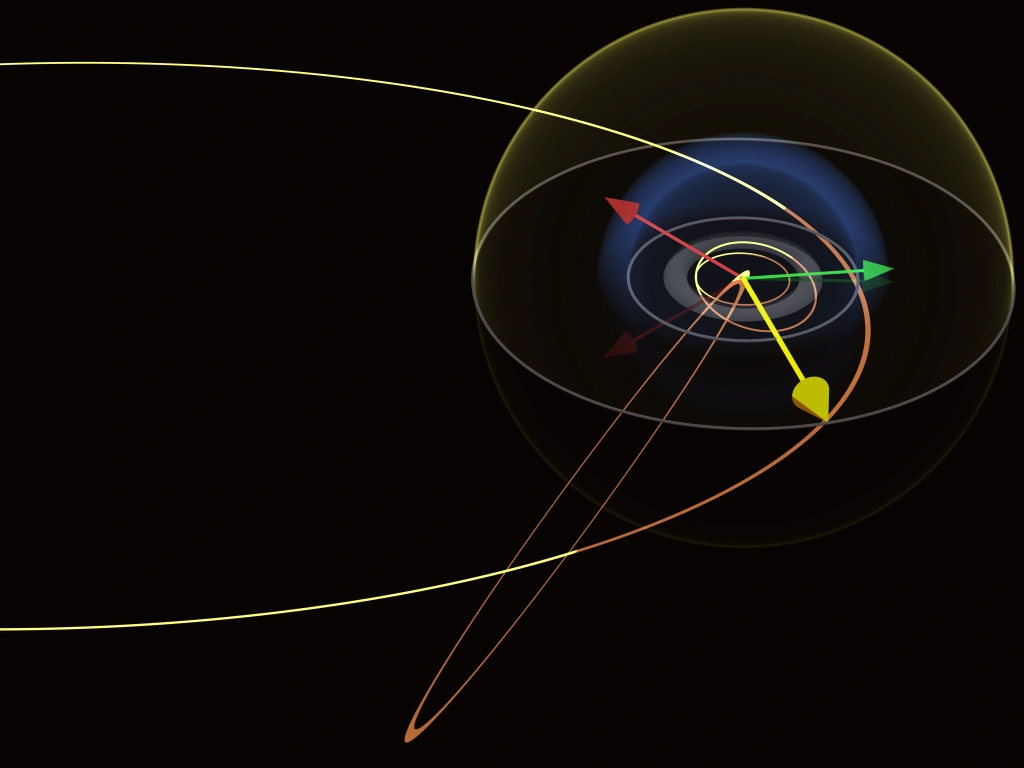

The yellow shell indicating one light-day distance from the Sun compares in size with the positions of Voyager 1 and Pioneer 10 (red and green arrows respectively). It is larger than the heliosphere's termination shock (blue shell) but smaller than Comet Hale-Bopp's orbit (faint orange ellipse below). Click on the image for a larger view and links to other scales.
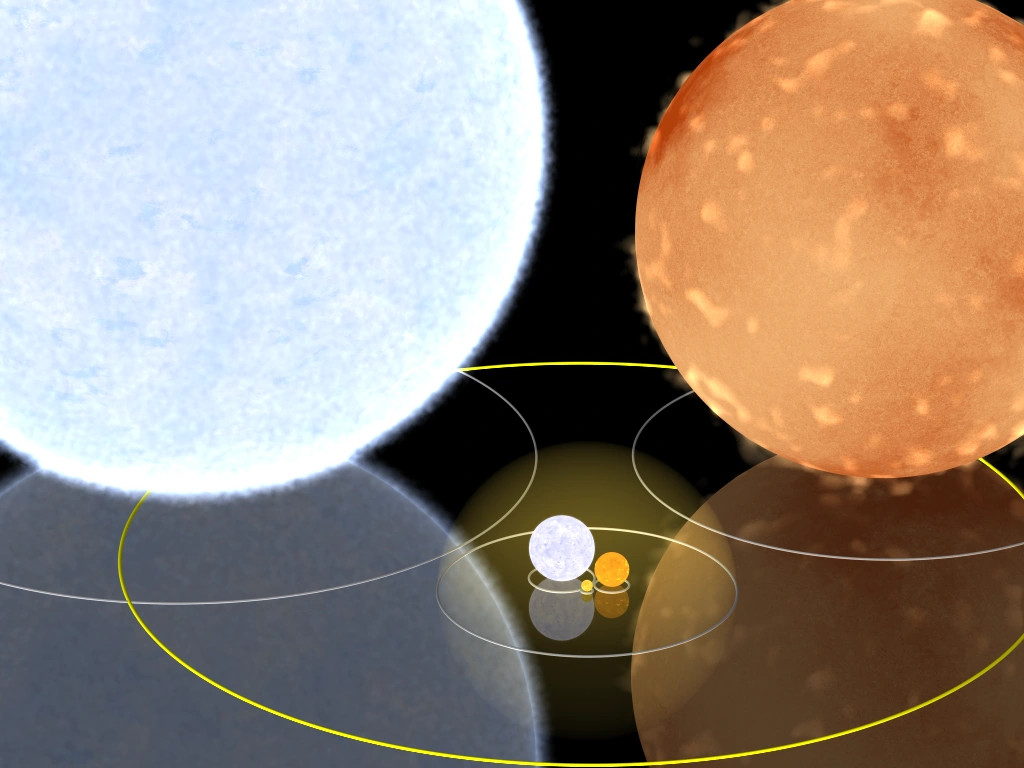

The faint yellow sphere centered on the Sun has a radius of one light-minute. For comparison, sizes of Rigel (the blue star in the top left) and Aldebaran (the red star in the top right) are shown to scale. The large yellow ellipse represents Mercury's orbit.
The light-second is a convenient unit for measuring distances in the inner Solar System, because it corresponds very closely to the radiometric data used to determine them (the match is not exact for an Earth-based observer because of a very small correction for the effects of relativity). The value of the astronomical unit in light seconds is a fundamental measurement for the calculation of modern ephemerides (tables of planetary positions): it is usually quoted as "light-time for unit distance" in tables of astronomical constants, and its currently accepted value is 499.004786385(20) s.[3][4]
- The mean diameter of the Earth is about 0.0425 light-seconds.
- The average distance from the Earth to the Moon is about 1.282 light-seconds.
- The diameter of the Sun is about 4.643 light-seconds.
- The average distance from the Earth to the Sun is 499.0 light-seconds.
Multiples of the light-second can be defined, although apart from the light-year they are more used in popular science publications than in research works. For example, a light-minute is 60 light-seconds and the average distance from the Earth to the Sun is 8.317 light-minutes.
Distance units based on the speed of light
| Unit | Definition | Distance | Example | ||
| m | km | miles | |||
| light-second | 2.997924580×10⁸ m | 2.998×10⁵ km | 1.863×10⁵ miles | average distance from the Earth to the Moon is about 1.282 light-seconds | |
| light-minute | 60 light-seconds | 1.798754748×10¹⁰ m | 1.799×10⁷ km | 1.118×10⁷ miles | average distance from the Earth to the Sun is 8.317 light-minutes |
| light-hour | 60 light-minutes = 3600 light-seconds |
1.079252849×10¹² m | 1.079×10⁹ km | 6.706×10⁸ miles | semi-major axis of Pluto's orbit is about 5.473 light-hours |
| light-day | 24 light-hours = 86400 light-seconds |
2.590206837×10¹³ m | 2.590×10¹⁰ km | 1.609×10¹⁰ miles | Sedna is currently 0.52 light-days from the Sun |
| light-week | 7 light-days = 604800 light-seconds |
1.813144786×10¹⁴ m | 1.813×10¹¹ km | 1.127×10¹¹ miles | The Oort cloud is thought to extend between 41 and 82 light-weeks out from the Sun |
| light-year | 365.25 light-days = 31557600 light-seconds |
9.460730473×10¹⁵ m | 9.461×10¹² km | 5.879×10¹² miles | Proxima Centauri is the nearest star to the Sun, about 4.24 light-years away |
References
- ↑ IAU Recommendations concerning Units
- ↑ Template:SIbrochure8th
- ↑ Standish, E. M. (1998), JPL Planetary and Lunar Ephemerides, DE405/LE405, JPL IOM 312.F-98-048, http://iau-comm4.jpl.nasa.gov/de405iom/de405iom.pdf.
- ↑ McCarthy, Dennis D.; Petit, Gérard, ed. (2004), "IERS Conventions (2003)", IERS Technical Note No. 32, Frankfurt: Bundesamts für Kartographie und Geodäsie, ISBN 3-89888-884-3, http://www.iers.org/MainDisp.csl?pid=46-25776.
See also
- Light-year
- Beard-second
- Geometrized unit system